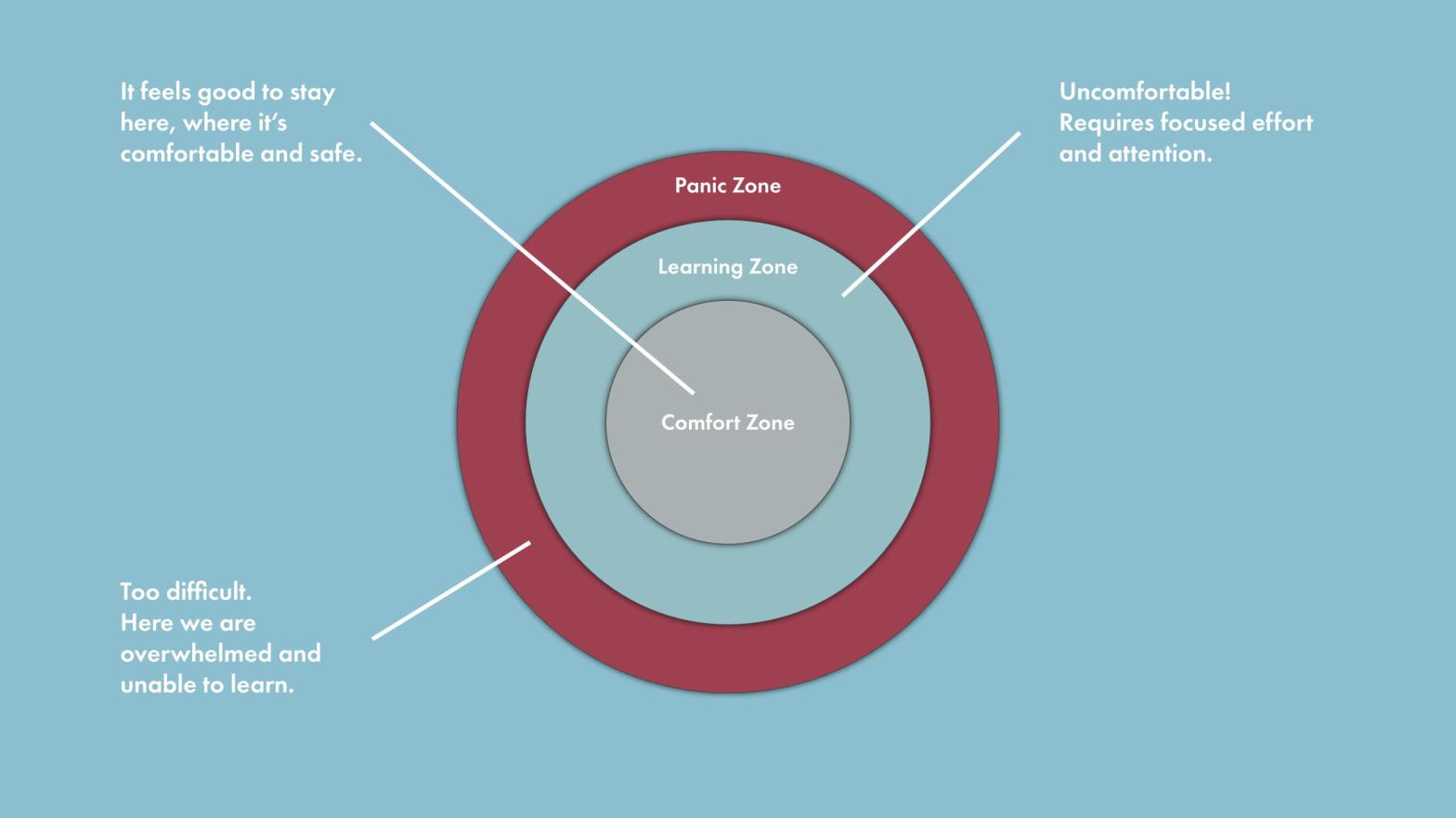
The Learning Zone Model demonstrates how – in order to learn successfully – we must be challenged. But the balance needs to be just right.
Tom Senninger, a German Educator and Adventurer, formulated the Learning Zone Model, drawing inspiration from Lev Vygotsky’s Zone of Proximal Development. This model encourages us to view positive encounters as opportunities for learning and aids individuals in comprehending and broadening their boundaries and comfort zones.
The Learning Zone Model illustrates that, for effective learning, we must face challenges. Striking the right balance is crucial: if the challenge is too easy, we won’t move beyond our Comfort Zone; if it’s too difficult, we become overwhelmed. In both cases, learning becomes hindered. Instead, we should aim for the “optimal point,” which is the Learning Zone.
- When individuals encounter something new, they often grapple with questions like: Can I accomplish this? Do I possess enough knowledge? What should I do?
- This uncertainty signifies their transition from the Comfort Zone to the Learning Zone.
- It’s important to note that experiencing some level of uncertainty can be beneficial. However, feeling helpless and panicked indicates the Panic Zone, where the learning process breaks down.
- Maintaining the right balance between uncertainty and control is key to keeping individuals within their Learning Zone.

The model categorizes the learning experience into three primary zones:
- The Comfort Zone: In your daily work, you likely have routine tasks that you perform competently. This familiarity is your Comfort Zone. While it offers stability and a chance to rest, staying in this zone for too long can hinder skill and idea development.
- The Learning Zone (or Growth Zone): Beyond the Comfort Zone lies the Learning Zone, where your existing skills are stretched, enabling you to acquire new ones. Though initially intimidating, the Learning Zone is an adventure where curiosity, questions, and calculated risks are encouraged. A moderate level of pressure fosters growth without inducing panic. With time, the skills acquired in the Learning Zone may become part of your Comfort Zone.
- The Panic Zone: The outermost zone is the Panic Zone, where you venture beyond your familiar territory and reasonable learning expectations. Here, you may feel overwhelmed by unrealistic demands and information overload, leading to heightened stress and fear of failure. The Panic Zone can be demoralizing and aversive, discouraging individuals from returning to it.
 AliusArt